Cargo theft rarely starts with a Hollywood-style break-in. More often, it starts with a parked trailer, a weak locking point, and a thief who already knows where standard hardware fails. That is why the best trailer security devices are not the cheapest add-ons in a catalog. They are the devices that force time, noise, specialized tools, and visible risk onto anyone trying to access your freight.
For fleet operators, trailer managers, and logistics teams, the real question is not whether a lock exists. It is whether that lock protects the actual point of attack. Too many products are built around convenience, not theft resistance. A trailer loaded with pharmaceuticals, food-grade products, electronics, or high-value retail freight needs a more serious standard.
What makes the best trailer security devices worth buying
The strongest trailer security devices do three jobs at once. First, they create a physical barrier that slows or stops forced entry. Second, they act as a visible deterrent that makes your trailer a harder target than the one parked next to it. Third, they support a defensible security program when customers, insurers, or internal risk teams ask what protections are in place.
That last point matters more than many fleets admit. A stolen load is not just a cargo claim. It can trigger service failures, damaged customer relationships, higher premiums, missed delivery windows, and expensive operational disruption. Security hardware should be evaluated the same way you would evaluate any other risk-control investment – by how well it reduces exposure where losses actually happen.
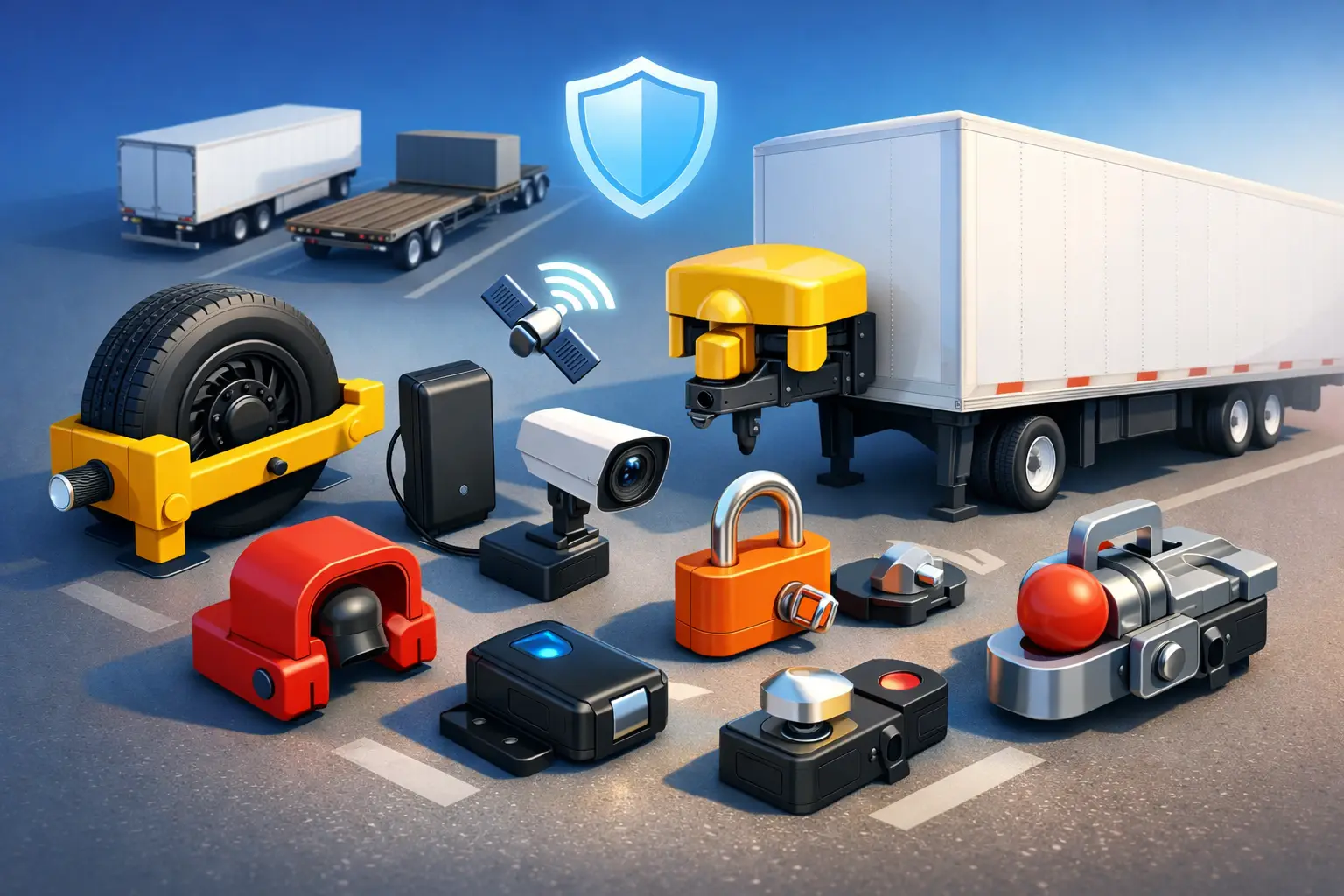
8 best trailer security devices to consider
1. Trailer door locks that secure the door, not just the handle
This is the category that deserves the closest attention. Many trailer thefts exploit a simple weakness: handle-based security. If a device only protects the handle assembly while the door itself remains vulnerable, the system may look secure without truly securing entry.
A purpose-built trailer door lock that physically locks the barn door creates a stronger line of defense. This approach matters on dry vans and refrigerated trailers where cargo thieves often target rear access. Devices in this category should use hardened steel, tamper-resistant design, and lock placement that limits exposure to cutting and prying tools.
For many operations, this is the most important upgrade because it addresses the attack point directly. Cargo Locks USA has built its approach around this exact principle, which is one reason door-focused systems stand apart from generic hardware.
2. Hardened padlocks with high-security cylinders
Not all padlocks belong in commercial trailer security. Basic retail padlocks can often be cut, drilled, shimmed, or picked quickly. A serious trailer security setup calls for hardened bodies, protected shackles or shackle-free designs, and cylinders engineered to resist manipulation.
This is where fleets should stop thinking in terms of commodity lock replacement. A padlock should be part of a security system, not a weak link attached to one. High-security options with proven resistance to cutting and drilling are better suited to unattended trailers, drop yards, and high-risk lanes.
3. King pin locks for detached trailers
When a trailer is dropped, king pin protection becomes part of the theft equation. A king pin lock can prevent unauthorized coupling, which helps stop whole-trailer theft and limits the ease with which criminals can move a target to a secondary location.
That said, a king pin lock does not protect the cargo doors. It solves a different problem. Fleets that rely on drop-and-hook operations often need both coupling protection and rear-door protection, especially if the load is attractive and the trailer may sit overnight.
4. Gladhand locks for brake and air system control
Gladhand locks restrict access to trailer air lines and can make unauthorized movement harder. They are useful in yards, terminals, and any situation where a detached trailer sits exposed for long periods.
Still, this device is best viewed as a movement deterrent rather than a cargo access solution. If your primary concern is load theft through the rear doors, gladhand locks help, but they should not be your only layer.
5. Landing gear locks
Landing gear locks prevent thieves from quickly raising trailer legs and preparing a unit for movement. Like king pin and gladhand locks, they are part of anti-tow and anti-movement strategy.
Their value depends on your operating model. Fleets with frequent trailer drops, remote staging areas, or high trailer dwell times may benefit more than operations with tightly controlled yards. They can be effective, but they work best when paired with stronger access control at the doors.
6. Electronic cargo seals and tamper-evident seals
Seals have a place in trailer security, but fleets should be honest about what they do. A plastic or metal seal is usually a tamper indicator, not a forced-entry barrier. It tells you access may have happened. It rarely stops access from happening.
Electronic seals improve visibility and chain-of-custody tracking, which can be valuable for regulated or theft-sensitive freight. But if the freight itself justifies stronger physical protection, a seal alone is not enough. Use seals for accountability, not as your main theft-prevention device.
7. GPS trailer tracking and geofencing devices
Tracking devices help locate assets, monitor movement, and trigger alerts when a trailer leaves an approved area. They are valuable for recovery and operational visibility, especially across large fleets or dispersed trailer networks.
But GPS is not physical security. It can tell you a trailer is moving or gone, yet do nothing to stop the initial breach. That distinction matters. Recovery is better than no visibility at all, but prevention is almost always cheaper than chasing a stolen load after the fact.
8. Yard barriers, lighting, and surveillance systems
These are not mounted on the trailer, but they still belong in the conversation. Camera coverage, controlled gate access, lighting, and perimeter barriers shape the environment around your equipment. They increase visibility and can deter opportunistic theft.
The limitation is obvious. A trailer eventually leaves the yard. Once it is at a truck stop, customer location, drop lot, or roadside stop, the trailer must carry much of its own protection. Site security helps, but trailer-mounted physical security is what travels with the risk.
How to choose the best trailer security devices for your operation
The right answer depends on what you haul, where you park, and how thieves are most likely to target your trailers. A carrier moving low-theft-risk freight on tightly managed regional routes may prioritize movement control and visibility. A reefer fleet carrying pharmaceuticals or food products through extended dwell times should place much more weight on hardened rear-door protection.
Start with your likely failure points. If thieves can attack the door in minutes, door security should lead the budget. If detached trailer theft is the larger problem, focus on king pin, gladhand, and landing gear controls. If your issue is chain-of-custody or location visibility, add seals and GPS. The strongest programs are built in layers, but the first layer should cover the most common attack path.
Material quality also matters. Premium steel construction, shielded lock components, weather resistance, and real tamper resistance are not cosmetic features. They determine whether a device survives field conditions and whether it holds up under attack. Fleets should ask hard questions about construction, not just price.
Common mistakes fleets make when buying trailer security
The first mistake is buying for appearance. Some products look heavy-duty but protect the wrong component or expose vulnerable parts to bolt cutters and pry tools. The second mistake is treating tamper evidence as theft prevention. A broken seal after the fact does not protect the load.
The third mistake is assuming one device solves every problem. It does not. A king pin lock will not secure the doors. GPS will not stop a cut lock. A yard camera will not help much once the trailer is parked offsite. Security decisions should match the threat, not the marketing copy.
There is also a procurement mistake that shows up often in larger fleets: standardizing on low-cost hardware for convenience. Cheap hardware scales losses just as efficiently as premium hardware scales protection. If one weak device becomes your fleet standard, you have standardized vulnerability.
Where the best trailer security devices deliver the most value
The highest return usually shows up where freight value, theft risk, and dwell time intersect. That includes drop lots, overnight parking, shipper yards, cross-dock staging, and any operation moving attractive cargo through predictable lanes. In those settings, a strong visible lock can do more than resist attack. It can cause target displacement, which is often the difference between a quiet night and a six-figure problem.
A serious security device also helps operationally. Drivers know the equipment is built for the job. Customers see a stronger cargo protection posture. Risk managers and insurers see evidence that the fleet is not relying on minimal compliance measures.
Trailer security is not about checking a box. It is about making the trailer materially harder to steal from or steal outright. If your current setup would only slow a determined thief for a minute or two, that is not a security program. That is a warning sign. The best trailer security devices are the ones that protect the real attack point, hold up under pressure, and give your operation fewer chances to learn the cost of weak hardware the hard way.